
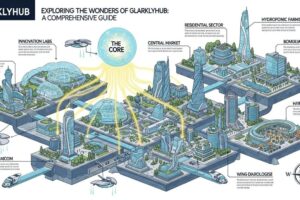
In the ever-expanding universe of digital tools promising to streamline our work and ignite our creativity, a new constellation has appeared, shining with peculiar intensity. Its name is Glarklyhub. You may not have heard of it yet—it hasn’t reached the household-name status of the Slacks or Notions of the world—but within specific, vibrant communities, it’s sparking nothing short of a revolution. More than just another SaaS platform, Glarklyhub represents a philosophical shift in how we conceive of collaborative digital spaces, blending structured productivity with the unstructured magic of spontaneous connection.
At first glance, Glarklyhub presents a familiar facade: a browser-based environment with workspaces, project boards, and messaging channels. But to dismiss it as a clone would be to miss its radical core. While traditional platforms are built on the paradigm of tasks and timelines, Glarklyhub is built on the paradigm of context and convergence. Its foundational innovation is the “Dynamic Canvas,” an infinite, multi-layered workspace where text, images, code snippets, video embeds, and data visualizations don’t just sit side-by-side, but can be semantically linked, nested, and interacted with. A designer can sketch a wireframe on one layer, a developer can link functional requirements on a sub-layer beneath it, and a product manager can attach user stories that dynamically update as both evolve. This creates a living document of a project’s entire ecosystem, erasing the destructive divide between creation and documentation.
The magic of Glarklyhub, however, isn’t merely in its architecture, but in its emergent sociology. The platform has found its most fervent adopters not in corporate IT departments, but in what we might call the “new creators”: interdisciplinary research teams, open-source software collectives, indie game studios, and world-building storytellers. For these groups, the linear, thread-based conversation of traditional tools is a straitjacket. Their work is non-linear, associative, and deeply iterative. A narrative writer for a game might need to connect a snippet of dialogue directly to a concept artist’s mood board and a composer’s sound test, creating a holistic sensory reference that everyone can tap into simultaneously. Glarklyhub facilitates this by making serendipity a feature, not a bug. Its “Ambient Awareness” feed doesn’t just notify you when you’re tagged; it gently surfaces relevant activity from across the entire hub based on your interests and active projects, fostering collisions of ideas that would otherwise remain siloed.
This focus on convergence has led to the organic development of Glarklyhub’s most distinctive cultural artifact: the “Glark.” A Glark is more than a post or a comment. It is a unit of thought packaged with its native context. It could be a hypothesis with linked data sets, a critique anchored directly to the pixels of a design, or a brainstorming riff that pulls in references from across the web. Glarks are connective tissue. They can be “echoed” (not merely liked) into other project streams, carrying their context with them, allowing ideas to propagate and mutate healthily across different teams. This has given rise to a unique etiquette and collaborative literacy, where the value is placed on building upon, transforming, and connecting ideas rather than simply approving or rejecting them.
The technical underpinnings that enable this are as elegant as the user experience. Glarklyhub operates on a principle of “sovereign data.” Unlike platforms where your content is locked into proprietary formats, every element in Glarklyhub—every Glark, every canvas node—can be exported, via a robust API, as a standalone data object with its complete relationship map. This commitment to interoperability reflects a profound respect for the user’s intellectual investment. It has made the platform a darling of the “right-to-own” movement in tech, attracting those burned by platforms that have walled up or monetized their creative history.
Of course, no revolution is without its challenges and critiques. The very flexibility that empowers users can be daunting to newcomers. The absence of prescribed workflows means teams must invest time in developing their own conventions, a process that can feel chaotic. The learning curve, while shallow for the digitally native, can be steep for those accustomed to more rigid systems. Some early reviewers labeled it “beautiful but bewildering,” highlighting the tension between boundless potential and the human need for structure. Furthermore, its niche success raises questions about scalability. Can the intimate, connective culture of Glarklyhub survive a potential influx of millions of users, or would it succumb to the noise and fragmentation that plague larger networks?
Yet, these challenges may be precisely the point. Glarklyhub isn’t trying to be everything to everyone. It is a testament to the power of designing for a specific mode of thought and work. Its growing influence is less about dethroning the giants and more about proving an alternative is not only possible but thriving. It demonstrates that there is a massive, underserved market of knowledge workers and creators who have been bending rigid tools to fit their fluid processes, and who are hungry for a space built in their image.
The implications of Glarklyhub’s model extend beyond its own servers. It is a case study for the future of work software. It argues that the next breakthrough won’t be a faster task manager, but a tool that better mirrors the networked nature of human cognition and collective creativity. It suggests that the key to productivity in complex projects may not be stricter oversight, but richer context and lower friction for intellectual synthesis. In an age of remote and hybrid work, where the watercooler moments and hallway insights are often lost, Glarklyhub attempts to engineer those moments digitally, not through forced social channels, but through the very fabric of the work itself.
As we look ahead, the story of Glarklyhub is still being written. Will it remain a beloved niche tool, or will its philosophies seep into the mainstream, forcing incumbents to evolve? Its success already signals a clear demand. In a digital landscape often dominated by surveillance-driven engagement metrics and one-size-fits-all solutions, Glarklyhub stands as a beacon of human-centric design. It provides a canvas not just for projects, but for building a more intelligent, interconnected, and ultimately more human way of working together. It reminds us that collaboration, at its best, isn’t about managing tasks—it’s about weaving minds. And in that ambitious, glimmering goal, Glarklyhub is not just a hub, but a harbinger.